Step 1 of 6
Three keys, three roles
The client makes a throwaway client keypair. The remote signer has its own key for talking, and holds the user key that actually signs. Signer key and user key may be the same, but clients must not assume it.
NIP-46
DraftEvents
Keeps your secret key in one place, a "bunker", and lets apps ask it to sign. The app and the bunker talk through encrypted kind 24133 events on relays, using JSON-RPC-style requests such as sign_event, get_public_key and nip44_encrypt.
Edit the form or the JSON: both stay in sync, the badge says whether the result is valid, and tapping any field explains it.
How the parts connect: Signing a note with a remote signer
Not signed yet · Demo keys only. These personas' secret keys are public on purpose.
Select any field in the form or the JSON to see what it does.
Step 1 of 6
The client makes a throwaway client keypair. The remote signer has its own key for talking, and holds the user key that actually signs. Signer key and user key may be the same, but clients must not assume it.
All requests and responses are NIP-44 encrypted.
Signers may announce relays and a connect URL in nostr.json.
Signers may announce themselves as kind 31990 apps handling kind 24133.
Browser extensions are the in-browser alternative to a remote signer.
Android signer apps are the on-device alternative.
Specification text is quoted in English from the nostr-protocol/nips repository. Our explanations and the interface are translated. Source on GitHub at commit 0046368
remote-signer-key is introduced, passed in bunker url, clients must differentiate between remote-signer-pubkey and user-pubkey, must call get_public_key after connect, nip05 login is removed, create_account moved to another NIP.
Private keys should be exposed to as few systems - apps, operating systems, devices - as possible as each system adds to the attack surface.
This NIP describes a method for 2-way communication between a remote signer and a Nostr client. The remote signer could be, for example, a hardware device dedicated to signing Nostr events, while the client is a normal Nostr client.
sign_event requests, for example). The remote-signer generally has control over these keys.All pubkeys specified in this NIP are in hex format.
client-keypair. This keypair doesn't need to be communicated to user since it's largely disposable. client might choose to store it locally and they should delete it on logout;client-pubkey, client learns remote-signer-pubkey.client-keypair to send requests to remote-signer by p-tagging and encrypting to remote-signer-pubkey;p-tagging and encrypting to the client-pubkey.get_public_key to learn user-pubkey.There are two ways to initiate a connection:
remote-signer provides connection token in the form:
bunker://<remote-signer-pubkey>?relay=<wss://relay-to-connect-on>&relay=<wss://another-relay-to-connect-on>&secret=<optional-secret-value>
user passes this token to client, which then sends connect request to remote-signer via the specified relays. When connecting this way client SHOULD include optional_client_metadata in the connect request (see Client metadata), since unlike nostrconnect:// this token carries no information identifying client. Optional secret can be used for single successfully established connection only, remote-signer SHOULD ignore new attempts to establish connection with old secret.
client provides a connection token using nostrconnect:// as the protocol, and client-pubkey as the origin. Additional information should be passed as query parameters:
relay (required) - one or more relay urls on which the client is listening for responses from the remote-signer.secret (required) - a short random string that the remote-signer should return as the result field of its response.perms (optional) - a comma-separated list of permissions the client is requesting be approved by the remote-signername (optional) - the name of the client applicationurl (optional) - the canonical url of the client applicationimage (optional) - a small image representing the client applicationHere's an example:
nostrconnect://83f3b2ae6aa368e8275397b9c26cf550101d63ebaab900d19dd4a4429f5ad8f5?relay=wss%3A%2F%2Frelay1.example.com&perms=nip44_encrypt%2Cnip44_decrypt%2Csign_event%3A13%2Csign_event%3A14%2Csign_event%3A1059&name=My+Client&secret=0s8j2djs&relay=wss%3A%2F%2Frelay2.example2.com
user passes this token to remote-signer, which then sends connect response event to the client-pubkey via the specified relays. Client discovers remote-signer-pubkey from connect response author. secret value MUST be provided to avoid connection spoofing, client MUST validate the secret returned by connect response.
kind: 24133{
"kind": 24133,
"pubkey": <local_keypair_pubkey>,
"content": <nip44(<request>)>,
"tags": [["p", <remote-signer-pubkey>]],
}
The content field is a JSON-RPC-like message that is NIP-44 encrypted and has the following structure:
{
    "id": <random_string>,
    "method": <method_name>,
    "params": [array_of_strings]
}
id is a random string that is a request ID. This same ID will be sent back in the response payload.method is the name of the method/command (detailed below).params is a positional array of string parameters.Each of the following are methods that the client sends to the remote-signer.
| Command | Params | Result |
|---|---|---|
connect |
[<remote-signer-pubkey>, <optional_secret>, <optional_requested_perms>, <optional_client_metadata>] |
"ack" OR <required-secret-value> |
sign_event |
[<{kind, content, tags, created_at}>] |
json_stringified(<signed_event>) |
ping |
[] |
"pong" |
get_public_key |
[] |
<user-pubkey> |
nip04_encrypt |
[<third_party_pubkey>, <plaintext_to_encrypt>] |
<nip04_ciphertext> |
nip04_decrypt |
[<third_party_pubkey>, <nip04_ciphertext_to_decrypt>] |
<plaintext> |
nip44_encrypt |
[<third_party_pubkey>, <plaintext_to_encrypt>] |
<nip44_ciphertext> |
nip44_decrypt |
[<third_party_pubkey>, <nip44_ciphertext_to_decrypt>] |
<plaintext> |
switch_relays |
[] |
["<relay-url>", "<relay-url>", ...] OR null |
logout |
[] |
"ack" |
The connect method may be provided with optional_requested_perms for user convenience. The permissions are a comma-separated list of method[:params], i.e. nip44_encrypt,sign_event:4 meaning permissions to call nip44_encrypt and to call sign_event with kind:4. Optional parameter for sign_event is the kind number, parameters for other methods are to be defined later. Same permission format may be used for perms field of metadata in nostrconnect:// string.
The connect method may be provided with optional_client_metadata so that remote-signer can identify and label the connection. It is a JSON-stringified object whose fields mirror the nostrconnect:// query parameters, all optional:
name - the name of the client applicationurl - the canonical url of the client applicationimage - a small image representing the client applicationThis is most useful for a connection initiated by remote-signer (the bunker:// flow), where — unlike nostrconnect:// — remote-signer has no other source for this information. To send metadata without requesting permissions, an empty string MUST be passed for optional_requested_perms so that the metadata occupies the fourth position. The metadata is client-supplied and unauthenticated; remote-signer SHOULD treat it as a display hint only and MUST NOT use it for authorization decisions.
At all times, the remote-signer should be in control of what relays are being used for the connection between it and the client. Therefore it should be possible for it to evolve its set of relays over time as old relays go out of operation and new ones appear. Even more importantly, in the case of the connection initiated by the client the client may pick relays completely foreign to the remote-signer's preferences, so it must be possible for it to switch those immediately.
Therefore, compliant clients should send a switch_relays request immediately upon establishing a connection (always, or at reasonable intervals). Upon receiving such requests, the remote-signer should reply with its updated list of relays, or null if there is nothing to be changed. Immediately upon receiving an updated relay list, the client should update its local state and send further requests on the new relays. The remote-signer should then be free to disconnect from the previous relays if that is desired.
When the user logs out of the client, the client MAY send a logout request to inform the remote-signer that the session is no longer needed. Upon receiving such a request, the remote-signer SHOULD remove the session associated with the requesting client-pubkey and reject any further requests from it (a new connect would be required to re-establish a session). The remote-signer should reply with "ack" before removing the session.
The logout request is a courtesy hint and is not a security boundary: the remote-signer MUST NOT rely on it being sent, and the client MUST still delete its locally stored client-keypair on logout regardless of whether the request was acknowledged.
kind:24133{
"id": <id>,
"kind": 24133,
"pubkey": <remote-signer-pubkey>,
"content": <nip44(<response>)>,
"tags": [["p", <client-pubkey>]],
"created_at": <unix timestamp in seconds>
}
The content field is a JSON-RPC-like message that is NIP-44 encrypted and has the following structure:
{
    "id": <request_id>,
    "result": <results_string>,
    "error": <optional_error_string>
}
id is the request ID that this response is for.results is a string of the result of the call (this can be either a string or a JSON stringified object)error, optionally, it is an error in string form, if any. Its presence indicates an error with the request.Requests made with unknown or unsupported methods MUST be replied with an error.
remote-signer-pubkey is fa984bd7dbb282f07e16e7ae87b26a2a7b9b90b7246a44771f0cf5ae58018f52user-pubkey is also fa984bd7dbb282f07e16e7ae87b26a2a7b9b90b7246a44771f0cf5ae58018f52client-pubkey is eff37350d839ce3707332348af4549a96051bd695d3223af4aabce4993531d86{
"kind": 24133,
"pubkey": "eff37350d839ce3707332348af4549a96051bd695d3223af4aabce4993531d86",
"content": nip44({
"id": <random_string>,
"method": "sign_event",
"params": [json_stringified(<{
content: "Hello, I'm signing remotely",
kind: 1,
tags: [],
created_at: 1714078911
}>)]
}),
"tags": [["p", "fa984bd7dbb282f07e16e7ae87b26a2a7b9b90b7246a44771f0cf5ae58018f52"]], // p-tags the remote-signer-pubkey
}
{
    "kind": 24133,
    "pubkey": "fa984bd7dbb282f07e16e7ae87b26a2a7b9b90b7246a44771f0cf5ae58018f52",
    "content": nip44({
        "id": <random_string>,
        "result": json_stringified(<signed-event>)
    }),
    "tags": [["p", "eff37350d839ce3707332348af4549a96051bd695d3223af4aabce4993531d86"]], // p-tags the client-pubkey
}

An Auth Challenge is a response that a remote-signer can send back when it needs the user to authenticate via other means. The response content object will take the following form:
{
    "id": <request_id>,
    "result": "auth_url",
    "error": <URL_to_display_to_end_user>
}
client should display (in a popup or new tab) the URL from the error field and then subscribe/listen for another response from the remote-signer (reusing the same request ID). This event will be sent once the user authenticates in the other window (or will never arrive if the user doesn't authenticate).
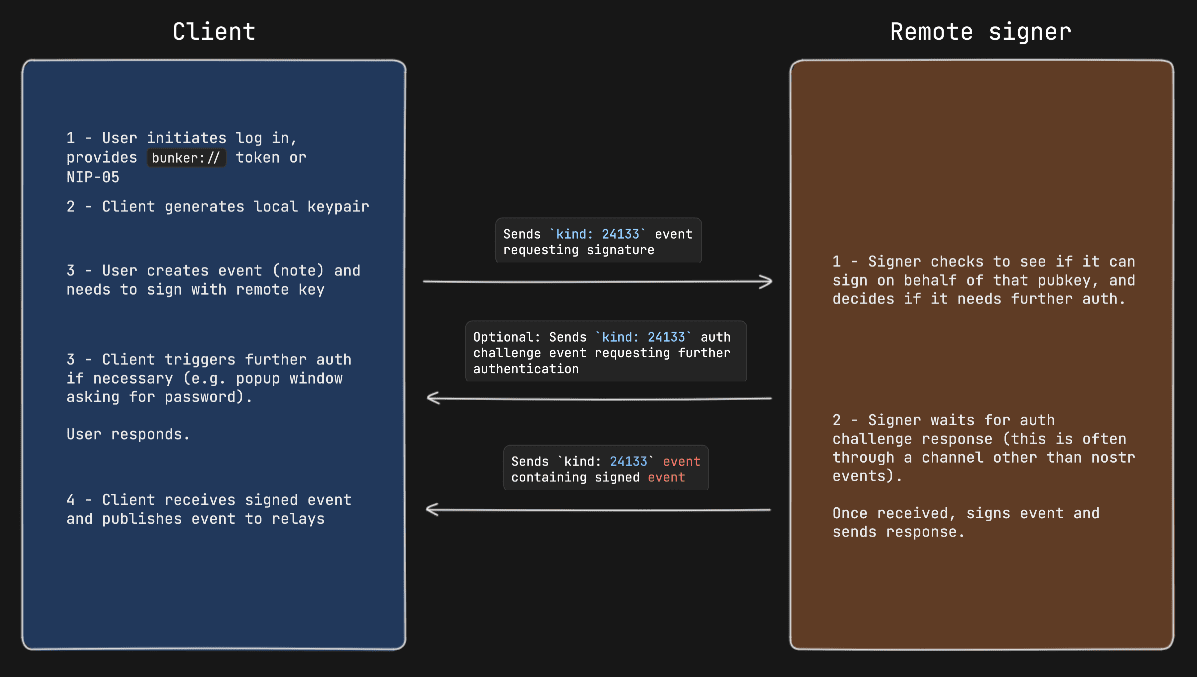
remote-signer MAY publish its metadata by using NIP-05 and NIP-89. With NIP-05, a request to <remote-signer>/.well-known/nostr.json?name=_ MAY return this:
{
    "names":{
        "_": <remote-signer-app-pubkey>,
    },
    "nip46": {
        "relays": ["wss://relay1","wss://relay2"...],
        "nostrconnect_url": "https://remote-signer-domain.example/<nostrconnect>"
    }
}
The <remote-signer-app-pubkey> MAY be used to verify the domain from remote-signer's NIP-89 event (see below). relays SHOULD be used to construct a more precise nostrconnect:// string for the specific remote-signer. nostrconnect_url template MAY be used to redirect users to remote-signer's connection flow by replacing <nostrconnect> placeholder with an actual nostrconnect:// string.
remote-signer MAY publish a NIP-89 kind: 31990 event with k tag of 24133, which MAY also include one or more relay tags and MAY include nostrconnect_url tag. The semantics of relay and nostrconnect_url tags are the same as in the section above.
client MAY improve UX by discovering remote-signers using their kind: 31990 events. client MAY then pre-generate nostrconnect:// strings for the remote-signers, and SHOULD in that case verify that kind: 31990 event's author is mentioned in signer's nostr.json?name=_ file as <remote-signer-app-pubkey>.